FORMA / SOURCE PACKAGE 1.3
FORMA.
A considered room.
A consistent decision.
A fictional architectural configurator connecting room choices, a material board, and a local brief.
- Context
- Fictional independent demo · AI-assisted
- Evidence
- Source Package 1.3
- Implementation boundary
- React · native WebGL2
SVG fallback · local exports
01 / THE BUILDA room that remembers the decision
FORMA is an independent, fictional portfolio demonstration: a bright architectural configurator built around one room and a small, coherent set of material choices. It is not a paid architectural engagement, a measured renovation, or a purchasable furniture catalogue.
The interesting problem is continuity. A treatment selected in Room Studio should still be the same treatment in the material board, the written brief, and the downloaded record. Visual polish matters, but it cannot substitute for a consistent decision model.
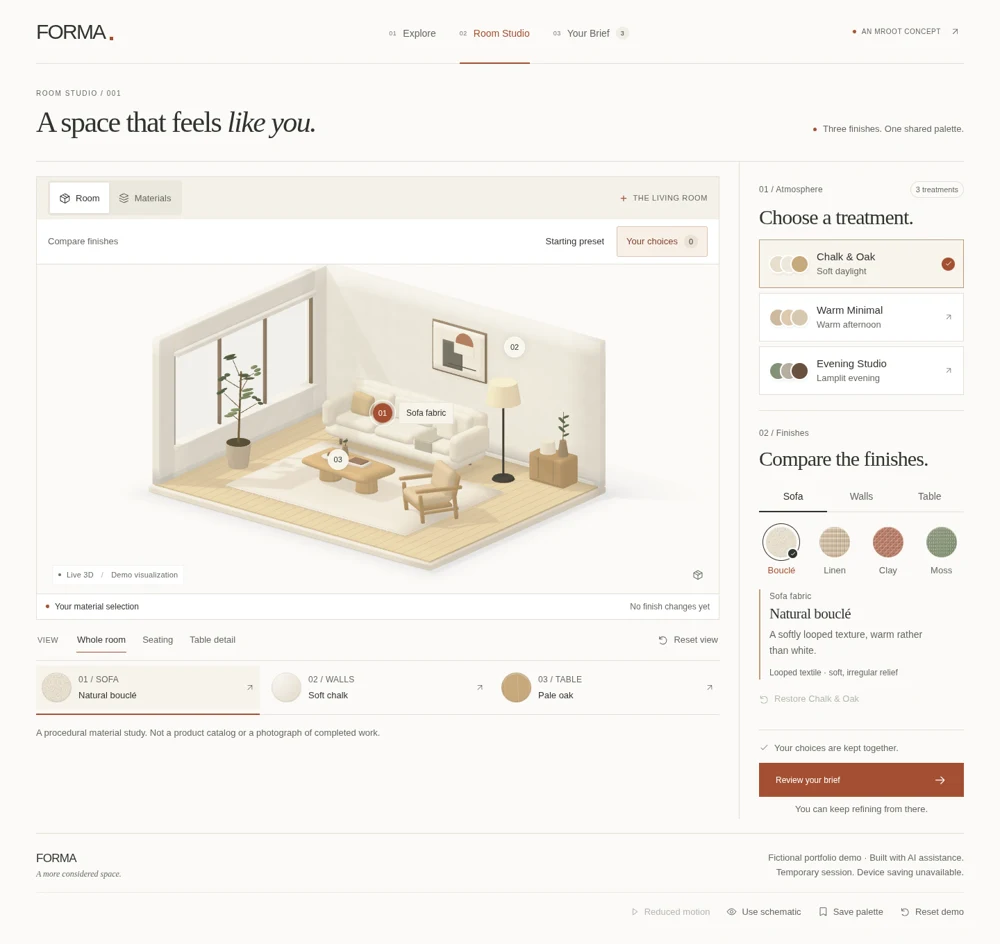
The supplied v1.3 source takes that constraint seriously. Three starting treatments—Chalk & Oak, Warm Minimal, and Evening Studio—lead into individual sofa, wall, and table choices. The starting-preset comparison is view-only: looking back should not silently overwrite the visitor’s current choices.
02 / THE BUILDOne selection, three readable outputs
LOCAL TEACHING MODEL / NOT THE APPLICATION
One choice. A consistent brief.
One preset / one selected palette
Chalk & Oak
The selected treatment drives the material list and the illustrative snapshot together.
{ "preset": "chalk", "materials": { "sofa": "boucle", "wall": "chalk", "table": "oak" } }This portfolio figure is a deliberately smaller teaching model. It changes a preset, a material list, and an example snapshot together. It does not run FORMA’s renderer, save browser data, or export a real project brief. The supplied application does more: it lets visitors tailor the room, develop a brief, and download Markdown or JSON locally.
A saved palette and an exported brief are different objects. In the v1.3 source, explicit Save palette stores validated option identifiers and selected preference chips. It does not store the room name, free-text preferences, notes, or contact information. A visitor must choose to restore the saved palette; there is no silent restoration or background autosave.
03 / THE BUILDThe image is not the state
The supplied renderer is a focused native WebGL2 cutaway room, with procedural geometry and three finite camera views. It is not an AI-generated room photograph, an unrestricted 3D editor, or a measurement tool. A labeled SVG schematic remains available when the 3D renderer cannot run; that fallback does not pretend to offer the same camera controls.
The brief is still useful without a cinematic camera move. It carries the selected materials and written preferences into a local export. The print action opens the browser’s print workflow; it is not a built-in PDF-generation service.
Version 1.3 also addresses smaller reliability details: focus after note removal, feedback at the eight-note limit, retrying 3D initialization, and cleaning up a partially initialized renderer. Those are supplied-source behaviors, not proof that every browser or GPU has been tested.
04 / THE BUILDWhat the evidence supports
The live domain returned the FORMA title and a JavaScript-required notice during this pass. Interactive live navigation was blocked in the test environment, so no live room configuration, save, export, or deployed source version was verified.
The exact v1.3 source handoff was recovered from the Library. Its 20 state tests passed again using the installed TypeScript compiler. That is a bounded source check, not a successful clean install of the pinned toolchain, a full production build, or a native browser persistence test. The image above comes from that package’s supplied evidence, not from a new live-site capture.
05 / THE BUILDKeep the next release honest
Before publication, reproduce the pinned build, check the deployed revision, and exercise real browser navigation, explicit save/restore, export, keyboard use, and renderer failure on supported devices. No backend, account, cloud sync, quote, payment, or enquiry-delivery feature is implied by this project record.
The contribution this demonstration makes to the portfolio is specific: a tactile interface whose scene, controls, brief, and local data boundaries tell the same story.
Source, dates, and what this page verifies
Editorial review: September 30, 2026. This is a local MRoot portfolio reference, not a published site update.
The supplied package, local test workspace, and live domain are separate evidence surfaces. Browser navigation to the live domain was blocked by the environment. No deployed source revision or real live mutation is claimed.
The interactive figure is a bounded teaching model, not the application. Source-package imagery retains its supplied provenance; it is not newly captured live evidence. See docs/final/SOURCE-REVIEW.md and PUBLICATION-BLOCKERS.md in the handoff.