SIGNAL / SOURCE PACKAGE 1.2
SIGNAL.
From enquiry.
To a clear next step.
A fictional rules-based workflow with a human review gate and a separately tested local dispatch boundary.
- Context
- Fictional independent demo · AI-assisted
- Evidence
- Source Package 1.2
- Implementation boundary
- DOM + optional WebGL2
Local Node HTTP · SQLite
01 / THE BUILDMake automation inspectable
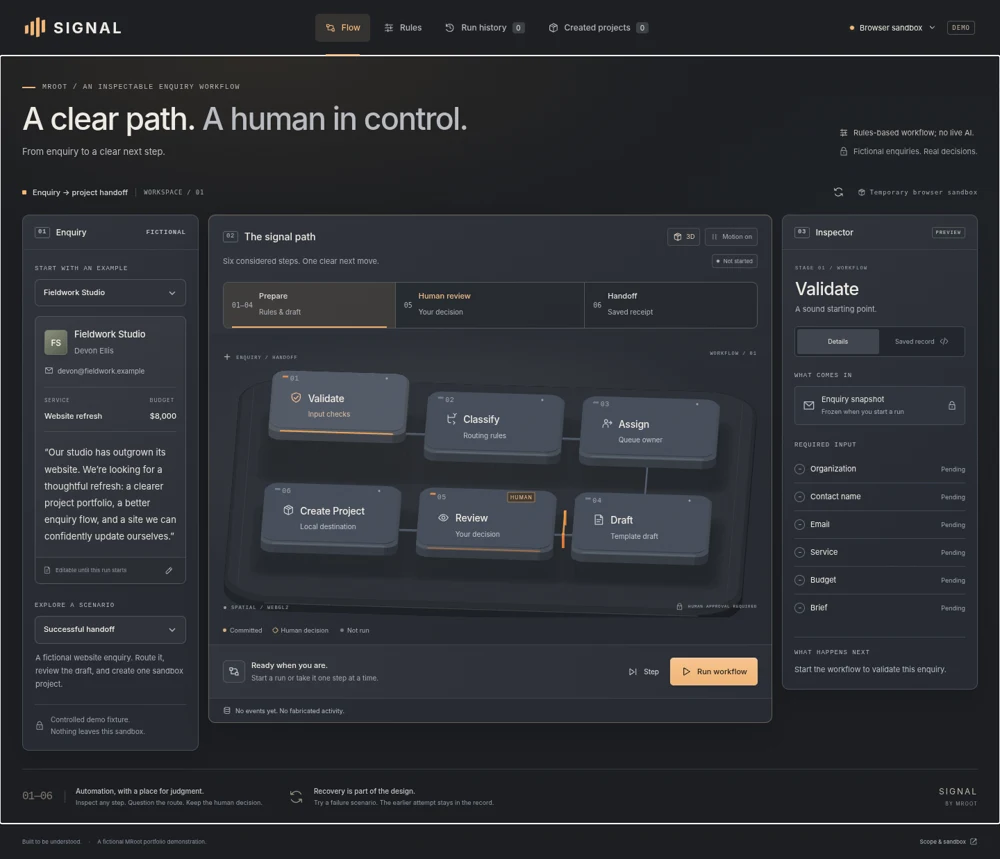
SIGNAL is a fictional enquiry-processing demonstration. It turns a small, deterministic workflow into something a person can inspect: Validate, Classify, Assign, Draft, Review, then Create Project. It does not use a live language model and does not process real customer enquiries in this portfolio reference.
The visual treatment makes the sequence spatial without hiding the decisions in a canvas. WebGL2 provides an optional stage; the meaningful controls remain in the DOM. A flatter presentation supports smaller screens, reduced motion, forced colors, and renderer failure.
The product question is not whether a diagram can animate through six steps. It is whether the system can show why it paused, what was approved, and whether a downstream action actually happened.
02 / THE BUILDA green run is not permission to send
LOCAL TEACHING MODEL / NOT THE APPLICATION
Keep a person at the decision.
ILLUSTRATIVE DECISION
Pause for human review
A valid run and generated draft are not permission to create a project.
This interactive figure explains four bounded states. It never contacts a destination, creates a project, or simulates a successful production response. Approval and dispatch remain separate even when the draft is eligible.
The supplied source freezes the input and rule snapshot. Classification follows deterministic priority and stable identifiers, and unmatched input takes a human-review route. Approval is bound to the run, input hash, rule version, and draft version. Editing the draft invalidates that approval; the earlier decision cannot authorize different text.
That makes the review stage a real boundary rather than an animation delay. It is the point where a person can compare the generated draft with the frozen evidence and choose what should happen next.
03 / THE BUILDWhen the acknowledgement disappears
The local Node HTTP and SQLite backend persists an outbox intent and operation key. A controlled HTTP destination enforces uniqueness for that operation. If an acknowledgement is lost after creation, the backend can reconcile the receipt against the destination record instead of treating uncertainty as permission to create another project.
This is not a claim of universal “exactly once” delivery. It describes the supplied controlled destination and its tested rules. There is no autonomous outbox polling service, live CRM integration, or production email delivery in this package. The standalone browser adapter illustrates the states; it does not provide the backend’s durable storage or transactional guarantees.
History replay is read-only. Replaying committed events should explain what happened, not invoke another mutation.
04 / THE BUILDFail closed without discarding the work
Version 1.2 bounds HTTP requests and response bodies, preserves corrupt storage bytes for recovery, and treats unknown write outcomes as a reason to refresh the read state. It does not silently switch from the API to a successful browser simulation. Pending actions lock the relevant dialog, while unsaved rule and draft changes have explicit preservation or discard behavior.
These safeguards are supplied-source behaviors with separate test evidence. They do not turn a local demo identity into production authentication. Optional Vite and Hono paths remain unverified, and Worker/D1 support has not been implemented.
05 / THE BUILDEvidence, not implied deployment
The live domain returned SIGNAL’s document title, but the fetch supplied no useful interactive body. Browser navigation was blocked, so no live rule editor, review, dispatch, or deployed source revision was verified.
The exact 1.2 Library package was inspected. Its initial test run failed before domain tests because the TypeScript loader dependency was missing. After explicitly using the installed TypeScript 5.8.3 compiler in the extracted test workspace, all 65 tests passed. This is a disclosed toolchain substitution, not a clean install or a fresh deployment. The source package also documents narrower UI type-checking coverage than its native core.
The next publication checks are the source/build relationship, pinned installation, native browser/API behavior, destination reconciliation, security configuration, and supported rendering fallbacks. Until those are verified, this record remains a fictional application demonstration with bounded evidence.
Source, dates, and what this page verifies
Editorial review: September 30, 2026. This is a local MRoot portfolio reference, not a published site update.
The supplied package, local test workspace, and live domain are separate evidence surfaces. Browser navigation to the live domain was blocked by the environment. No deployed source revision or real live mutation is claimed.
The interactive figure is a bounded teaching model, not the application. Source-package imagery retains its supplied provenance; it is not newly captured live evidence. See docs/final/SOURCE-REVIEW.md and PUBLICATION-BLOCKERS.md in the handoff.